

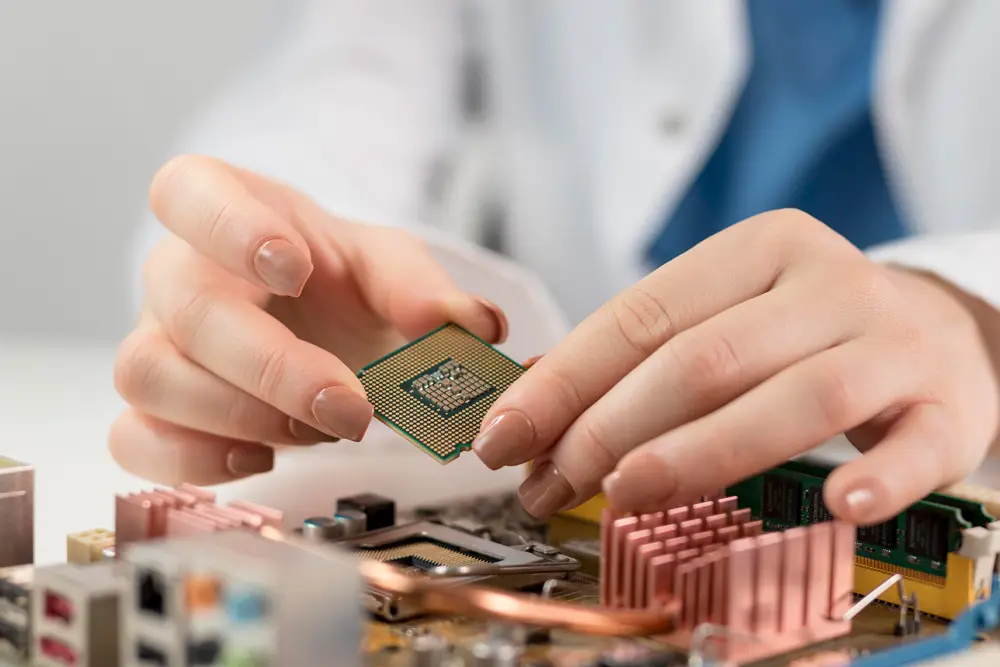
Physical Design & Chip Implementation
Learn how digital circuit architectures are transformed into manufacturable silicon layouts.
Duration
32 Hours
Mode
Classroom / Online
Course Overview
Physical design is the stage where chip architectures are converted into physical layouts ready for fabrication. This course introduces floorplanning, placement optimization, clock tree synthesis, and physical verification techniques used in modern semiconductor development.
Key Learning Modules
Module 1: Physical Design Flow Overview (4 hours)
Understand the complete RTL-to-GDSII implementation process.
- RTL-to-GDSII flow
- Libraries and process nodes
Module 2: Floorplanning & Power Planning (6 hours)
Learn strategies for chip floorplanning and power grid design.
- Floorplanning strategies
- Power grid design
Module 3: Placement & Optimization (6 hours)
Explore congestion analysis and layout optimization techniques.
- Congestion analysis
- Physical optimizations
Module 4: Clock Tree Synthesis (5 hours)
Study clock distribution strategies and timing management.
- CTS fundamentals
- Skew & latency control
Module 5: AI in Physical Design (6 hours)
Learn how machine learning helps optimize placement and routing.
- AI-based floorplanning (macro placement prediction)
- ML-driven placement and congestion mitigation
- AI-assisted CTS optimization
- Routing optimization using reinforcement learning
- IR-drop and EM prediction using ML
Module 6: Physical Verification & Tape-out (5 hours)
Understand DRC, LVS, STA, and tape-out preparation.
- DRC, LVS, STA sign-off
- Tape-out readiness
Skills You Will Gain
- Chip floorplanning
- Placement optimization
- Clock tree design
- Physical verification
Career Opportunities
- Physical Design Engineer
- Implementation Engineer
- Backend VLSI Engineer
Build Skills in Physical Chip Design
Join the next batch and start learning industry-level semiconductor design skills.